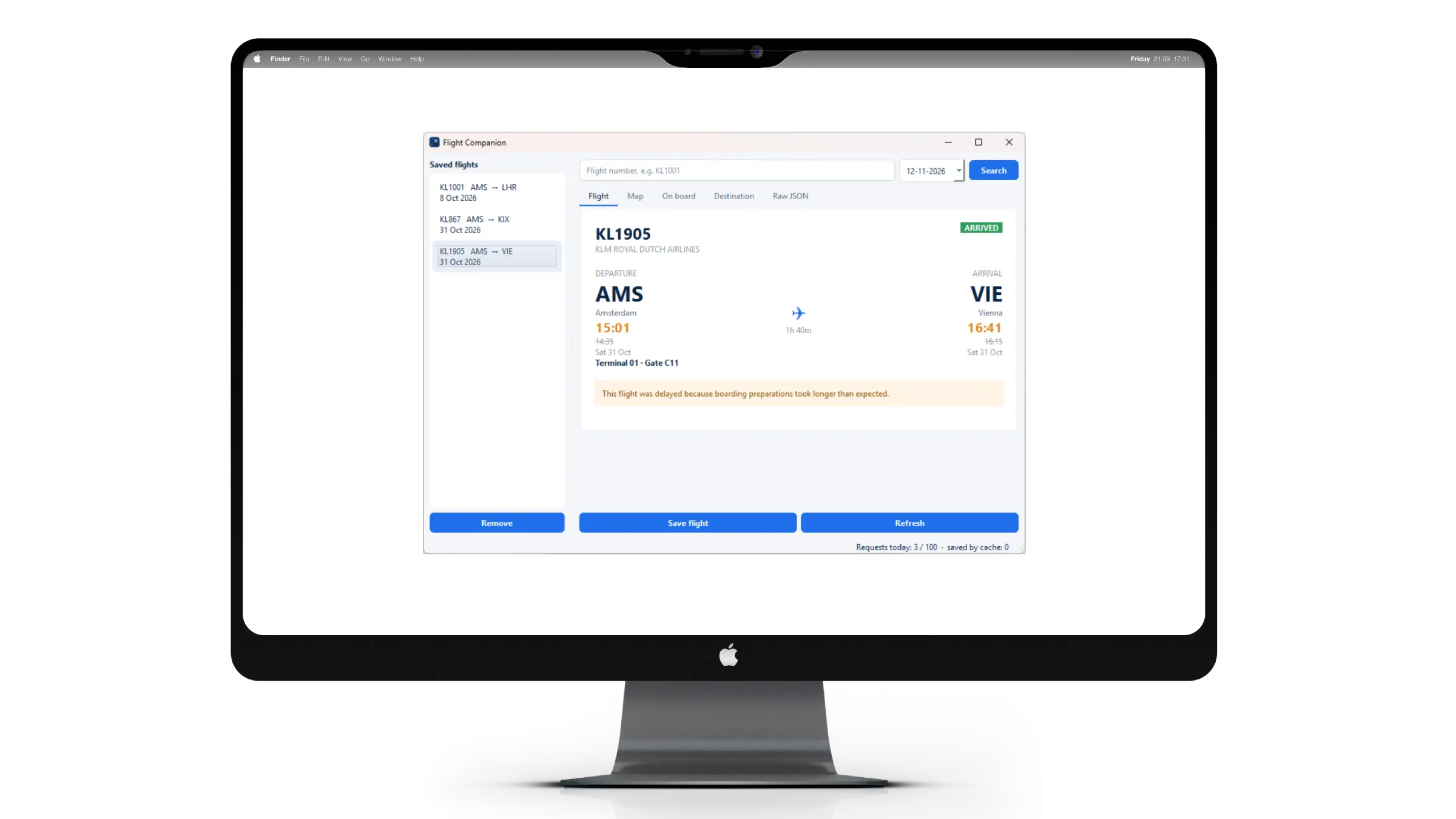
Overview
FlightCompanion is a completed offline-first desktop application built with C++23 and Qt 6. It lets users look up and save flights while keeping their information available when an internet connection is limited or unavailable.
The application reads saved flight data from local storage and uses network requests to update that data when connectivity is available. Alongside the implementation, I carried out research and benchmarks within the completed application to compare storage approaches and synchronization strategies.
Highlights
- Flight lookup and saving using the KLM Flight Status API.
- Offline access to saved flights, including a clear indication when displayed information comes from local storage.
- Offline route map drawn using a bundled world map, without depending on a network connection for the map itself.
- Destination weather at the expected arrival time, retrieved through Open-Meteo.
- Status-based refresh scheduling designed around a limit of 100 API requests per day.
- Automatic synchronization when the connection becomes available again.
Research
I researched how to keep flight information available and sufficiently up to date with limited network access. This involved a storage benchmark and a simulated travel day using the completed application.
- SQLite updated a single flight up to 85× faster than JSON in the measured benchmark, where the JSON approach rewrote the entire file after a change.
- Status-based refreshing used 29% fewer requests than refreshing every five minutes in the measured scenario, while maintaining the same observed freshness.
- Checking connectivity before making a request reduced the measured offline wait from 14.5 seconds to effectively immediate feedback.
The figures reflect the benchmark conditions and simulated scenarios, rather than guaranteed performance in every environment.
What I Learned
- Designing around interfaces so storage implementations and synchronization strategies can be swapped and compared fairly.
- Writing asynchronous network operations while keeping application state consistent as the user continues working.
- Managing memory and debugging C++/Qt applications, including tracing a crash that occurred only in Release builds.
- Questioning measurements, especially after identifying an artefact that initially made one strategy appear better than it was.
Status
Completed. Both the desktop application and its associated research were finished. The features listed above were implemented and working, and the research findings were measured as part of the project.
Credits
Flight data from the Air France-KLM Developer Portal · Weather data by Open-Meteo (CC BY 4.0) · World map from Natural Earth